This is a blog about Lappet-faced vultures in Oman

If you click on any images in the blog, it will be opened in a separate window, will be larger and it will be easier to see detail. Please leave comments!

Sunday, June 19, 2022

Vultures are fledging


A nestling Lappet-faced vulture.

As you may know from our previous posts (here), we are tracking juvenile Lappet-faced vultures via satellite.  As with many animals, the process of maturing is a gradual one for Lappet-faced vultures.  After hatching they may stay in their nest for a full 4 months before taking their first flight.  After that they develop their flying skills, but are pushed to do this rather quickly because they must search huge areas for their food.  The map below is of the movements of a vulture we marked in its nest just before its first flight.  Below are a couple of maps illustrating how the vulture has ranged farther and farther from its nest, as time has passed.  It is pretty amazing to me that a bird that has only been flying for about a month can travel so far!

Map of movements of a juvenile Lappet-faced vulture during 5 May - 19 June 2022. (Yellow = 5-19 May, Blue = 20 May-3 June, Red = 4-20 June) ©ESO, IAR.

Zoomed-in map of movements of a juvenile Lappet-faced vulture during 5 May - 19 June 2022. (Yellow = 5-19 May, Blue = 20 May-3 June, Red = 4-20 June) ©ESO, IAR.

The gradual process of maturation continues after that first flight, and it is only after 5-6 years that the vulture will become sexually mature, and may breed.  More about that in future blog posts, so check back for updates.

Wednesday, June 1, 2022

Tracking a Lappet-faced vulture

A nestling Lappet-faced vulture that has been fitted with a GPS-GSM tracking device.  Ali Al Rasbi is the one without the feathers, and is a member of ESO's vulture team.  ©ESO, IAR.

In May 2022 the ESO vulture team, Environment Authority employees and volunteers from the public fit GPS-GSM tracking devices to nestling Lappet-faced vultures from the Hajar Mountains.  The nestlings were found by our team and cooperators earlier this year, and we have been monitoring their progress as they grow.  When they were old enough, but before they had flown (about 100 days old), we fit some of them with tracking devices, and placed them back in their nest.  Some days/weeks later the nestlings take their first flight ("fledge"), and we are able to follow their movements with the help of the trackers.

The tracking devices weigh about 50 grams, small enough to cause no harmful effects to the vultures (which weigh 6.5 - 8 kg!).  The devices are attached using a custom-made, Teflon, pelvic harness that does not interfere with flight.  Getting the fit right is important - too tight and it will injure the bird, too loose and it will hang from the bird and may affect flight.  In future blog posts we'll explain more about the devices and tracking, and you'll learn as we go along.

The solar powered GPS-GSM tracking device on Lappet-faced vulture 17139.  The bird's head has been covered to keep it calm.  © ESO, IAR.

Below is a map of movements of a young Lappet-faced vulture fitted with a tag on 5 May 2022, first as it sat on then nest, and then as it made more and wider excursions from the nest during its first flights.  Currently it has the romantic name of "171379", which is the identification number of its tracking device.  As you can see, at the moment most of the locations are clustered in the north.  That is where the nest is.  You can also see that it made a rather long excursion to the south (the distance between the nest and the location farthest south).  As time passes, this bird will expand its ranging, and (assuming it survives), will cover vast areas in search of its food: rather large dead animals.

Movements of a juvenile Lappet-faced vulture during 5 - 31 May 2022, when the bird fledged and started to move more widely in the area around the nest. The arrow indicates its last location.  The distance north to south is about 15 km. © ESO, IAR.

If this is your first visit to the blog, then you might want to look at our first post (here) for some background.  In the coming days, weeks and years we'll be posting about other vultures being tracked, and about the biology, ecology and conservation of Lappet-faced vultures in Oman.  So, come back every so often or follow us with the button in upper right corner, and tell your friends and family about the blog.  Also, comment or ask questions in the comments box below.


Wednesday, May 18, 2022

The Lappet-faced vulture in Oman

Adult Lappet-faced vulture (Torgos tracheliotos) 

The Lappet-faced vulture (Torgos tracheliotos) is a large, globally endangered vulture that breeds in The Middle East, Arabia and eastern and southeastern parts of Africa. It typically feeds on the remains of rather larger animals, a habit facilitated by its large size (6-8 kg, wingspan 2+ meters) and huge beak. As with other vultures, they search for their food over huge areas, a task enabled by its ability to soar efficiently on updrafts of hot air produced in the mostly hot, arid area where they occur.

Lappet-faced vultures mature slowly, reaching adulthood after about six years.  However, they can also live long (over 30 yrs). Before maturity Lappet-faced vultures probably wander widely, mostly in search of food.  When they enter the breeding population their movement, which might still cover large areas, is anchored to the nesting location.  Breeders build huge nests, often in flat-topped trees, like Acacia tortilis.  They lay a single egg, but not in all years. Chicks remain in the nest for around 4 months, and when they leave they are as large as their parents. Chicks probably remain in contact with their parents for some months after making their first flight.

Lappet-faced vultures face a wide range of threats that vary geographically and include, changes in food availability, electrocution, persecution and accidental poisoning.

Click here and here to read more.

In Oman Lappet-faced vultures are most common in the Hajar Mountains in the north, but they also breed in flatter areas of the central desert and in Dhofar.  Their ecology in Oman is much as it is elsewhere. They range over huge areas (including probably UAE and Saudi), and feed on the carcasses of large animals (goats, camels, donkeys). They lay a single egg in a large nest (often in Acacia tortilis) in remote, and mostly rugged areas.  

Omani Lappet-faced vultures are sometimes electrocuted, hit by cars, and persecuted. They are also facing changes in food availability because natural populations of larger animals (like gazelle) are declining, and changes are occurring in animal husbandry and waste management. Although historically they have been regularly seen, almost nothing was known about their status in Oman.  

This blog is about Lappet-faced vultures in Oman.  In 2020 the Environment Society of Oman (ESO) and International Avian Research won support from the Disney Conservation Fund to conduct research and promote conservation of this iconic and important species.  Additional support has been given by the Anglo-Omani Society in a grant to F. Al Lamki. In subsequent posts we will be discussing that research and providing general information about Lappet-faced vultures, the habitats in which they live and the other animals that share their (and our) environment.

171379 is in UAE

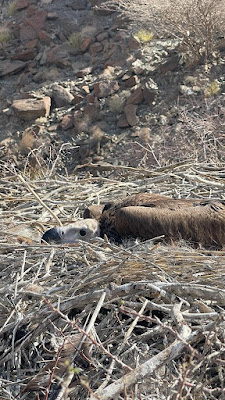
  Lappet-faced vulture (ID=171379) in its nest before fledging.  ©ESO, IAR. Vultures are obligate scavenging birds, meaning they don’t hunt ...